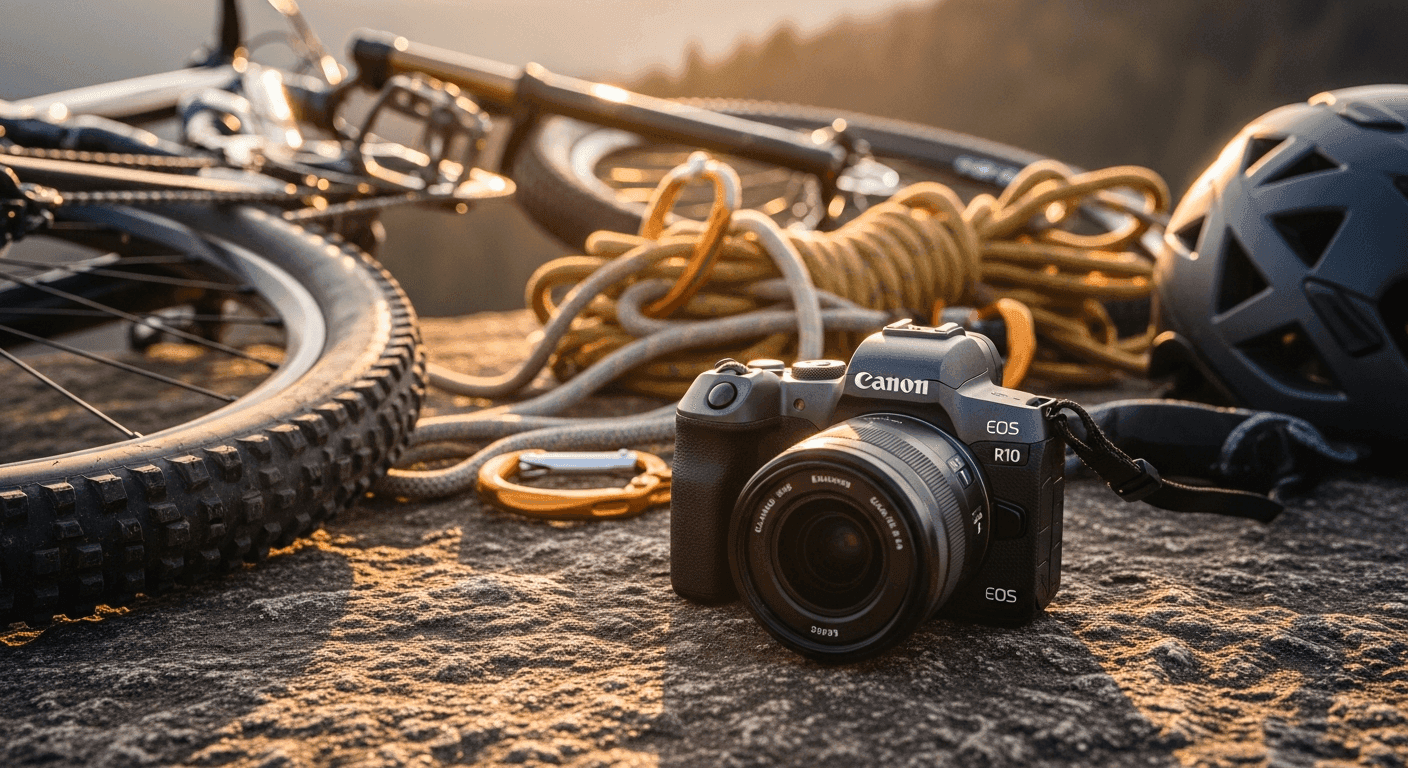
Action photographers have spent years wrestling with the weight and complexity of professional DSLR systems, only to watch mirrorless technology lap them in speed and capability. The shift isn't just happening—it's accelerating, and the Canon EOS R10 is leading the charge for photographers who refuse to compromise on performance.
Wildlife photographers and sports enthusiasts are ditching their bulky DSLRs for something faster, lighter, and surprisingly affordable. The Canon EOS R10 mirrorless camera with its 18-150mm lens has quietly become the go-to system for capturing split-second moments—delivering frame rates that rival cameras costing twice as much.
Explore the Canon EOS R10 at Camera House today.
Canon's R-series has earned serious credibility in the mirrorless world, and the EOS R10 brings that professional DNA to photographers who refuse to compromise on performance or portability. This APS-C powerhouse combines a 24.2MP sensor with advanced autofocus technology found in Canon's flagship models, bundled with a versatile 18-150mm lens that handles everything from landscape sweeps to telephoto reach. Whether you're tracking birds in flight, capturing decisive sports moments, or documenting fast-paced events, this system punches well above its price point.
Burst Speed and Autofocus Performance: Built for Fast-Action Capture
The moment you press the shutter button, you'll feel the difference between competent and exceptional. The EOS R10 achieves 23 frames per second with its electronic shutter—a speed that historically belonged to cameras commanding five figures. Switching to the mechanical shutter yields a still-impressive 15 fps, perfect for extended shooting sessions where battery conservation matters.
The real magic lives in the autofocus system. Canon's Dual Pixel CMOS AF II technology, inherited directly from the flagship EOS R3, powers 651 AF zones with 5,940 selectable positions. This dense focus array means your subject stays locked regardless of where it sits in the frame. The camera's animal eye-tracking doesn't just work for wildlife—it handles birds in flight with remarkable accuracy, a feat that separates serious birding cameras from the rest. Vehicle tracking capabilities extend the system's reach into motorsports and automotive photography, where tracking moving subjects at high speeds determines whether you capture the shot or miss it entirely.
During video recording, the autofocus maintains real-time tracking, producing smooth, professional-grade footage without the hunting and hunting characteristic of lesser systems. Content creators shooting documentaries or event coverage benefit immensely from this capability—the camera does the heavy lifting while you control composition and timing.
The 18-150mm Lens: Versatility Without the Lens-Swapping Hassle
Bundled with the camera, the RF-S 18-150mm f/3.5-6.3 IS STM lens covers everything from 18mm wide angles to 150mm telephoto reach. That 8.3x zoom ratio eliminates the constant lens-swapping dance that drains energy and creates missed moments in fast-paced situations. The compact, lightweight design complements the camera's portability—you're carrying a complete zoom system that weighs significantly less than a traditional DSLR with dual lenses.
Optical image stabilization in this lens performs admirably in low-light conditions and handheld shooting scenarios, compensating for camera shake without requiring expensive in-body stabilization. The STM motor operates silently, essential for wildlife work where camera noise can spook subjects, and delivers fast, smooth autofocus during video recording.
For detail-oriented work, the lens achieves respectable minimum focusing distances, enabling macro-style photography when subjects warrant close-up treatment. The telephoto reach proves invaluable for sports and wildlife coverage—wildlife photographers can maintain safer distances from unpredictable subjects while still filling the frame with detail.
Check Camera House for current pricing and bundle options.
Video Production Capabilities for Content Creators and Documentarians
The EOS R10 captures 4K UHD 8-bit recording at up to 30p, internally oversampled from 6K for enhanced detail and sharpness. This oversampling process extracts maximum resolution from the sensor, producing video that stands up to color grading and post-production work. Push to 4K 60p, and you gain high-frame-rate capability for slow-motion sequences—though a crop factor applies at this setting, slightly narrowing your wide-angle coverage.
The 2.36-million-dot OLED electronic viewfinder delivers accurate exposure and focus monitoring, critical when determining whether your settings match your creative intent. The 3.0-inch vari-angle touchscreen LCD rotates and tilts to accommodate low-angle, overhead, and creative perspectives impossible with fixed screens. Content creators documenting from unconventional angles, or capturing selfie-style content, benefit tremendously from this flexibility.
Autofocus tracking during video capture means your subjects remain sharp as they move through the frame, producing dynamic, professional-looking sequences without manual focus adjustments.
Portability and Design: Travel Photography Made Practical
The compact APS-C form factor represents a fundamental advantage over full-frame mirrorless systems that demand backpack real estate and create shoulder fatigue on multi-day expeditions. Lightweight construction distributes the shooting load across extended sessions—all-day event coverage or extended wildlife staking doesn't leave your neck and shoulders screaming by sunset.
The vari-angle touchscreen isn't merely a convenience feature; it's a creative tool. Ground-level perspectives, overhead compositions, and creative angles that traditional fixed screens prevent become accessible and intuitive. The ergonomic grip and button layout accommodate intuitive control during extended sessions, reducing the learning curve for photographers transitioning from DSLRs.
Where the R10 Excels: Ideal Use Cases and Shooting Scenarios
Wildlife photography represents the EOS R10's sweet spot. Bird tracking and animal behavior capture demand precisely what this system delivers—relentless autofocus, burst speed that captures decisive moments, and a zoom lens that maintains subject distance. Safari documentarians benefit from the compact form factor, allowing longer shooting days without equipment burden.
Sports and motorsports coverage finds similar advantages. High-speed action demands continuous subject tracking and sustained burst capacity, both core strengths. Travel and adventure photography gains a lightweight system designed for multi-day expeditions where every ounce matters. Event coverage—weddings, conferences, live performances with dynamic subjects—demands fast autofocus and consistent exposure across challenging lighting, territory where the R10 performs reliably.
Honest Limitations: Where the R10 Shows Its Boundaries
Battery life during intensive shooting requires spare batteries, particularly when leveraging high burst rates and continuous autofocus. This isn't a deficiency unique to the R10, but recognizing the constraint ensures realistic expectations.
The absence of in-body image stabilization (IBIS) means stabilization relies entirely on lens-based optical stabilization. This limitation matters most in low-light video work, where slower shutter speeds invite camera shake. Low-light performance, while good for an APS-C sensor, doesn't match the capabilities of full-frame competitors, a trade-off inherent to smaller sensors.
The 4K 60p crop factor affects wide-angle coverage at high frame rates, and the lack of a headphone jack prevents real-time audio monitoring during video recording. These are workflow considerations rather than fundamental capability gaps, but they demand awareness during planning.
The Verdict: Why Action Photographers Are Making the Switch to the R10
The Canon EOS R10 mirrorless camera with 18-150mm lens represents a genuine inflection point for action photographers tired of compromise. You're getting professional-grade autofocus, blistering 23fps burst speeds, and a compact system that doesn't require a sherpa to carry—all for under $1,450. The 18-150mm lens alone eliminates the constant lens-swapping dance that drains energy and creates missed moments.
Where this camera truly shines is in scenarios where speed, accuracy, and portability converge. Wildlife photographers tracking unpredictable subjects, sports shooters following split-second action, and travel documentarians navigating tight spaces have found their sweet spot. The Dual Pixel CMOS AF II technology inherited from Canon's flagship models means your autofocus is doing the heavy lifting, freeing you to focus on composition and timing.
That said, this isn't a one-size-fits-all solution. The lack of in-body stabilization, weather sealing limitations, and battery constraints demand realistic expectations. But for the majority of action photographers seeking professional results without the full-frame price tag, the R10 delivers genuine value that's hard to ignore. If you're capturing fast-moving subjects, traveling frequently, or transitioning into mirrorless from DSLRs, this camera deserves serious consideration.
Visit Camera House to find the perfect Canon EOS R10 setup for your needs.